
Musicians of the 20th and 21st centuries have nearly forgotten the art of what was called “tempo rubare” or stealing time. The ability to add a multitude of timbres and dynamic swells has replaced the use of creative rhythm. In earlier periods, harpsichordists realized that the clarity of attack present in their instrument was ideal for accompanying nimble renaissance and baroque ensembles and instead of controlling volume dynamics, they honed their ability to distort the flow of time over the course of a performance in order to create intense expression. My mission is to utilize the harpsichord and the art of “stealing time” to craft visceral musical experiences through curated chamber concerts, nuanced theater productions and original compositions.
Ensemble Fiori
With Fiori Ensemble, I want to bring together early music instrumentalists and singers by whom I have been truly affected.
In the last century, early music has been pioneered by performer-researchers Arthur Haas and Robert Hill, and more recently by Edwin Huizinga, Skip Sempé and Olivier Fortin. After having had the good fortune to work with each of them, I have set out to explore the performance of ancient ensemble music in ways that have not yet been presented to modern audiences.
Historically informed performance practice, the spirit of constant improvisation, and even original compositions will be paramount in captivating both the hearts and attentions of listeners across generations. Inspired by Fiori Musicali, this 1635 publication of sacred and secular works by Girolamo Frescobaldi has provided inspiration to composers for hundreds of years.
THE FOLLOWING ARE ENTRIES TO DEVELOP INTO FUTURE IDEAS< ALL MEMBERS OF ENSEMBLE CAN ADD ENTRIES AND DEVELOP IDEAS
Baroque Arias of Resistance
Soprano Abigail Anderson and mezzo Gabi Razafinjatovo display the glorious baroque voice as they combine ancient classical oration with rhetorical vocalizations and gestures. The two Divas break modern conventions of performance in order to create a personal and emotional connection with their listeners and to challenge each audience member to resist the status quo. In a highly theatrical concert and touching interpretation of song, Baroque Arias of Resistance asks listeners to forget what they know about baroque singing and embrace the excitement of the unexpected.
Fiori Ensemble hosts Colorado’s first annual Festival of Ancient Music.
FOAM
Festival of Ancient Music
August 31-September 7 2025
Denver & Boulder Colorado
8.31.25 FIORI ENSEMBLE Baroque Arias of Resistance 7:30pm Grace Lutheran Boulder
9.1.25 Jerimiah Otto & Walton Lott Two Harpsichord Concerti 7:30pm Boulder Public Library
9.2.25 Ian Jones Solo Bach Violin Partitas 7:30pm Calvary Baptist Church
9.3.25 PLUGGED IN BAROQUE Jerimiah Otto Concert Installation performance at Sunrise Canyon Theater Boulder
9.3.25 PLUGGED IN BAROQUE with FIORI ENSEMBLE Concert Light Show 12:00pm Fiske Planetarium Boulder
9.3.25 SEICENTO SIRENE Claudio Monteverdi Concert 7:30pm Miner’s Alley Performing Arts Complex
9.4.25 TWELTH NIGHT with Joe Gailey, Theorbo/Lute 7:30pm People’s Building of Aurora 7:30pm
9.5.25 Carol Cordrescu & Jerimiah Otto French and German Traverso Boulder Public Library
9.6.25 Early Opera and Instrumental Masterclass with FIORI ENSEMBLE 10am-2pm Grace Lutheran Church
9.6.25 Marc’Antonio e Cleopatra Opera by Johann Adolph Hasse Abigail Anderson as Antony and Gabi Razafinjatovo as Cleopatra with FIORI ENSEMBLE 7:30pm Vintage Theater, Aurora
9.7.25 Early Opera and Instrumental Masterclass with FIORI ENSEMBLE 12pm-5pm Grace Lutheran Church
9.7.25 Student/Faculty Concert 7:30pm Grace Lutheran Church
Magnificent Timeists
A Live Radio Theater & Podcast @ Boulder Public Library
Magnificent Timeists invites audiences into a historical fantasy in which the phonograph was not invented by Thomas Edison’s workshop in 1877, but rather it was developed first by the Dorset Theater in London through the use of gold leaf, tin, pewter and even lead rather than alluminium foil. In this fictional history these recordings were preserved in the British National Museum along with all other machinery or deus machina involved in the productions of England’s first “Dramatick Operas” (1670-1700).
Inspired by Richard Hudson’s seminal work on the history of the mechanical metronome “Stolen Time: The History of Tempo Rubato”, this project reimagines how the music of earlier cultures was played. Vivid voice actors portray many musicians often heard about but never before HEARD FROM. Radio theater is uniquely suited to bring to life dramatic reconstructions of vignettes from the lives and works of William Shakespeare, Thomas Morley, Barbara Strozzi, Elizabeth Jacquet de La Guerre, Joseph Chevalier de Saintes Georges, Wolfgang Amadeus Mozart, Johann Sebastian Bach, Anna Bon and many more.
Seanpassion: The Passion of Sean Hannity
Jerimiah Otto chose the theme of this new work, The Passion of Sean Hannity, after a one year period spanning August 2024-August 2025 during which he listened to and made recordings from the Sean Hannity show on talk radio. The recorded segments archive Hannity and his guests, their absurd rhetoric and Southern Baptist worldviews. This project was born out of a simple idea: to listen to the conservative talk shows, in order to find a way to process modern politics and polarized worldviews. Rather than coming to terms with the perspectives of the conservative ilk, Otto found that the most natural way for him was to process these bizarre radio segments was setting them to music. Seanpassion: The Passion of Sean Hannity will will be workshopped and performed at the Boulder Public Library in December, 2025.
CLIMATE MUSIC
A CONCERT INSTALLATION @ BOULDER PUBLIC LIBRARY
With the debut album of Fiori Ensemble we will explore the reception and comprehension of climate events with music and will present modern science to the public in a way never previously attempted.
The original idea was the brain-child of Linda Scott Cummings, the founder of PaleoResearch Institute, herself a cellist and trustee of an early instrument collection in Pheonix, AZ. After originally connecting on the phone with Linda regarding her family’s instrument collection Linda informed me of her work at the PaleoResearch Institute and expressed a real conundrum.
“People are tone-deaf to climate news. That’s the best way to describe it.”
She said something to the affect of “At the institute we research and graph different environments, say Laramie Wyoming or Golden, or Boulder, these graphs show a consistent pattern of climate fluctuation for 40 thousand years and at the end of the graphs as it approaches modern day, the environment experiences a unique change. The large regular fluctuations disappear and a more regular temperate environment dominates… until the last several hundred years. During the final point of measurement on the graph, dramatic and irregular fluctuations occur.”
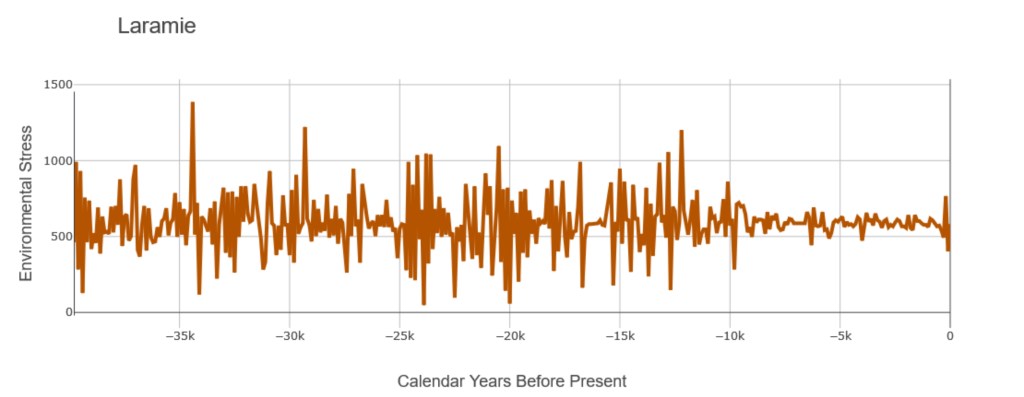
Linda told me she had represented the graph of Laramie Wyoming with an audio file attached. The frequency of the audio matches the information of the graph and gives an aural representation.
What can be heard is a regular and dissonant pattern of fluctuating high and low pitches, until… a flat line and three irregular shrieks finally at the very end. Already the data bears its first fruit: the environmental stress during an ice age period in Laramie 40 thousand years ago up to 10 thousand years ago sounds remarkably dissonant but with clear patterns. The end of the graph, however reveals not a patterned dissonance. As the environment fails to head back toward another ice age a shocking coincidence occurs. The contour of the final three stress events does not result in a dissonant sound, but instead it results in a chillingly in-tune D flat major triad (F-Ab-Db).
“This is the same data the public has been seeing for a long time now.”
Linda continued to say that she feels that people consistently tell her they do not understand climate news or can’t wrap their heads around the vast amount of time involved in the research presented. Linda continued on to lay out what would become a guiding question for the entire first iteration of this project, “What if we could create an original baroque/tonal composition based on the environmental stress events in the date? If the rules of the composition would account for both the regular fluctuations of an ice age environment and also the irregular fluctuations at the end of the graph, would people then be able to listen to the music and hear how at the end is so unlike anything that has come before it. Laramie, Wyoming is sending a crisis signal of environmental stress. We need to pay attention and act quickly.”
CLIMATE MUSIC
or a musical/chemical reaction to global ‘tone deafness’ toward climate crisis
With CLIMATE MUSIC “a musical/chemical reaction to global ‘tone deafness’ toward climate crisis” I aim to bring the members of Fiori Ensemble together with PaleoResearch Institute in order to merge the disparate worlds of Baroque musical composition and the Sciences of Archeology Geology. The understanding of each world will be enhanced through interdisciplinary approaches during a public workshop and several concert performances. Extensive geologic timeline research paired with original composition for both early instruments and acoustical-electrical instruments will present audiences with a concert installation event never attempted before.
 Jerimiah Otto